 1300 271 824


Cerebral Palsy · Guide
Daily Living with Cerebral Palsy: Equipment, Personal Care and High Intensity Supports
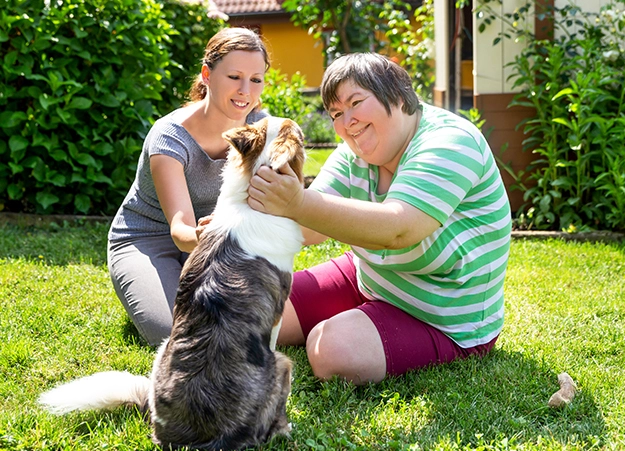
Most writing about cerebral palsy operates at the level of the condition. This guide operates at the level of a Tuesday.
Because that’s where a life with CP is actually lived — in whether the wheelchair cushion is right, whether the morning routine is rushed, whether the person is lifted safely, whether there’s enough energy left at 3pm to do something that isn’t maintenance. The clinical picture sets the parameters. The daily details determine the quality.
This covers the practical machinery of adult daily living with CP: seating and positioning, transfers and manual handling, personal care, continence, mealtimes, and the point at which support crosses into the NDIS high intensity skills descriptors.
It’s about what to look for and what to ask. Decisions about equipment and clinical care rest with your occupational therapist, physiotherapist, speech pathologist and treating team.
Seating and positioning: the foundation
If one thing on this list deserves disproportionate attention, it’s seating.
A wheelchair is not a chair. For someone who spends most of their waking hours in it, it’s a postural management system, a pressure management system and the primary interface with the world. Get it wrong and the consequences cascade — pressure injuries, pain, postural deterioration, scoliosis progression, respiratory compromise, fatigue, and a shrinking willingness to go anywhere.
What good seating does. Supports posture without over-restricting. Distributes pressure. Allows function — reaching, using a device, eating, seeing people at eye level where possible. Fits the person’s actual body, including asymmetries, rather than an idealised version of it.
Signs something is wrong. New or worsening pain. Sliding forward. Leaning increasingly to one side. Red marks that don’t fade within about twenty minutes of pressure relief. Reduced tolerance for sitting. Increased fatigue. A change in breathing or swallowing when seated.
Any of these warrant a seating review rather than an adjustment by whoever is nearby.
Review periodically, not only when something breaks. Bodies change. Weight changes. Posture changes. Equipment wears — cushions compress and stop doing what they were specified to do, often without looking any different. An OT seating review every year or two is cheap compared with a pressure injury.
Powered mobility deserves honest consideration. A persistent pattern among adults with CP: resisting a powered chair for years as a loss of ability, then describing it afterwards as the thing that gave them their life back. Powered mobility doesn’t replace walking for someone who walks — it replaces the exhaustion of walking distances that consume the day’s energy. Those are different things.
Transfers and manual handling
For people at GMFCS IV–V, transfers are the highest-risk routine activity in the day, for both the person and the worker.
Equipment. Ceiling hoists where the building allows, mobile hoists where it doesn’t, standing hoists for people with some weight-bearing, slide sheets and transfer boards for lateral transfers. All of it specified by an OT for this person, in this environment — not generic equipment that happens to be in the house.
Slings matter as much as hoists. Wrong size, wrong type, wrong positioning causes discomfort, skin damage and genuine danger. Slings should be prescribed, labelled, inspected regularly and replaced when worn.
Two-person transfers must be rostered as two-person transfers. This is worth stating bluntly because it’s one of the most common and consequential failures in CP support. Where the OT has specified two workers, a roster that funds one is not a cost saving — it’s either an injury or a person left waiting until someone else arrives.
Competency is person-specific. A worker trained in manual handling generally is not the same as a worker assessed as competent with this person, this hoist, this sling, this bathroom. Ask who assessed them and when.
Plan for equipment failure. A hoist that stops working on a Saturday is a person who cannot get out of bed. Ask every provider about response times for essential equipment and what the interim arrangement is.
Personal care
The most intimate part of support and the part most often rushed.
Time it honestly. Full personal care for an adult with high support needs — transfer, shower, dry, dress, position, oral care — commonly takes two to three hours in the morning. Rosters built on forty minutes create pressure that lands on the person as rushed handling, missed skin checks and lost dignity. If the roster doesn’t reflect reality, that’s a funding and planning problem, not something the person should absorb.
Skin checks are part of the routine, not an extra. Daily, during personal care, particularly over bony prominences. Pressure injuries develop faster than people expect and early detection is the whole game.
Oral health is routinely neglected and feeds back into nutrition, respiratory health and pain. Adults with disability have markedly poorer access to dental care. Build oral care into the daily routine and find a dentist experienced with adults with disability — they exist, and they’re worth travelling for.
Dignity is a practice, not a value statement. Doors closed. Asking before touching. Explaining what’s about to happen. Covering the person during transfers. Not conducting a conversation with a colleague over someone’s head while providing intimate care. These are observable behaviours, and you can see them or their absence within an hour of visiting a house.
Direction belongs to the person. Needing someone’s hands is not the same as needing their decisions. Many adults with CP direct their own care in precise detail — the order, the temperature, the positioning. A worker who follows that direction is doing the job correctly; one who overrides it for efficiency is not.
Continence
Common, under-discussed and genuinely improvable.
Continence issues affect a substantial proportion of adults with CP, and many have never had a proper continence assessment — they’ve simply managed privately for decades with whatever was worked out in childhood.
A continence assessment is worth requesting. Nurse continence specialists can often improve things substantially, through bladder and bowel programmes, equipment, medication review or timing strategies. The assumption that nothing can be done is frequently wrong.
Products and funding. Continence products may be funded through the NDIS as consumables, or through a state continence scheme, depending on circumstances. Clarify which applies rather than paying out of pocket by default.
Where support becomes high intensity. Complex bowel care — including digital stimulation, suppositories, enemas and stoma care — is one of the NDIS High Intensity Support Skills Descriptors. Workers delivering it must be assessed as competent for that specific person, under a plan written by an appropriate clinician. Our high intensity supports guides cover this in detail.
Mealtimes
Eating and drinking carry real risk for many people with CP, and mealtime support is an area where the gap between good and poor practice is stark.
EDACS — the Eating and Drinking Ability Classification System — describes safety and efficiency, from Level I (eats and drinks safely and efficiently) to Level V (cannot eat or drink safely; tube feeding considered). Levels III and above indicate genuine aspiration and choking risk.
A mealtime management plan should exist for anyone with swallowing difficulty, written by a speech pathologist, specifying texture, fluid consistency, positioning, pacing, supervision level and what to do if something goes wrong. It should be physically in the house and workers should be able to explain it, not just locate it.
Dysphagia support is a high intensity skills descriptor, added in the most recent revision. Workers need assessed competency for the specific person.
Texture-modified food should still be food. This matters more than clinical documentation suggests. Modified food that is unappetising leads to reduced intake, which creates a nutrition problem on top of a swallowing one. A house where texture-modified meals are prepared with any care at all is telling you something about its general standards.
Mealtimes are social. Someone eating a modified meal alone in another room while the household eats together is being fed efficiently and excluded completely. Where it’s safe, eat together.
Where enteral feeding applies, the detail is in our enteral feeding guide. The short version for CP specifically: a feeding tube is often experienced as a relief rather than a loss, particularly where mealtimes had become frightening or exhausting, and many people continue tasting food for pleasure alongside tube feeding where their speech pathologist assesses it as safe.
Where CP support meets high intensity supports
Adults with cerebral palsy frequently need one or more of the NDIS high intensity supports. Worth knowing which, because they change what competencies a provider needs.
| Support | When it commonly applies in CP |
|---|---|
| Dysphagia support | EDACS III and above; any swallowing difficulty |
| Enteral feeding support | Where oral intake is unsafe or insufficient |
| Complex bowel care | Common at higher GMFCS levels |
| Urinary catheter support | Where bladder management requires it |
| Complex wound care | Pressure injuries, post-surgical wounds |
| Epilepsy and seizure support | Epilepsy co-occurs with CP for a significant proportion of people |
| Subcutaneous injections | Where a prescribed regimen requires it |
For each one, the questions are the same: how many of your workers are assessed as competent for this person, who assessed them, when are they next due, and what happens on a sick day? A provider with one competent worker has a roster that collapses the first time someone is unwell.
The NDIS Commission recommends annual competency assessment, reassessment when needs change, and reassessment when a worker hasn’t delivered a support for three or more months.
The home itself
Equipment only works in an environment that accommodates it, and the building shapes daily life as much as anything in a care plan.
The things that matter most, roughly in order of how often they cause problems:
- Bathroom access. The single most common barrier. Room to manoeuvre a wheelchair or hoist, a level-entry shower, a toilet that can be transferred to, and enough space for a second worker where transfers need two.
- Doorway widths and turning circles. A chair that fits through a door but can’t turn once inside solves nothing.
- Level entry and the path from the street. Including in the rain, at night, with a carer, in an emergency.
- Bedroom size. Space for a hoist, a bed that can be approached from both sides, and storage for equipment that currently lives in a hallway.
- Kitchen access, where the person wants to cook or participate. Bench height, cupboard reach, appliance placement.
- Ceiling structure, if a ceiling hoist is in the picture. Not all roofs will take one without reinforcement.
Smart home technology is genuinely useful here and under-used. Voice or switch control of lights, doors, heating, blinds, television and intercom converts a series of tasks requiring a support worker into things a person does themselves. For someone with significant motor involvement but good communication, environmental control can meaningfully change the amount of independence in a day. It’s fundable as assistive technology and it’s worth raising with an OT.
Where modifications aren’t possible, the question becomes whether this is the right home. Our SDA guide covers specialist housing, which exists precisely for situations where ordinary housing cannot be made to work.
Nights, sleep and the hours nobody plans
Overnight support gets less attention than daytime support and causes a disproportionate share of problems.
Sleep is frequently disrupted for adults with CP — by pain, by difficulty repositioning independently, by spasticity, by reflux, by respiratory issues. Poor sleep then amplifies fatigue, pain sensitivity and everything else the next day. It’s worth treating as a clinical issue rather than an inevitability.
Repositioning overnight matters for pressure care and comfort. Where it’s needed, it should be scheduled, documented and actually happening — including at 3am, which is where overnight support quality is genuinely tested.
Sleepover versus active night is a classification with real consequences. A sleepover worker sleeps and wakes when needed; an active night worker is awake and working. The difference in cost is substantial and the difference in care is too. The classification should be based on logged overnight events across several weeks, not an estimate. Families frequently accept a sleepover arrangement when the data would support an active night, and the person spends years under-supported overnight as a result.
Positioning for the night needs the same attention as seating during the day — pillows, wedges, sleep systems where prescribed. An OT or physiotherapist should specify it, and workers should follow the specification rather than improvising.
Energy: the thing that shapes everything
A theme running through all of the above, and the one most often missing from support plans.
Movement with altered tone and compensatory patterns costs more energy than typical movement. For many adults with CP, the day has a hard ceiling that has nothing to do with motivation and everything to do with physiology.
What this means practically for daily living support:
Front-load the expensive tasks. If showering consumes a quarter of the day’s energy, it matters whether it happens before or after the thing the person actually wants to do.
Support should buy back time, not just complete tasks. The point of assistance with dressing isn’t only that clothes get on — it’s that the two hours saved go somewhere the person chose.
Build in recovery. A plan with activity scheduled from 8am to 8pm looks ambitious and produces a person who is exhausted by Wednesday.
Equipment is energy management. A powered chair, a shower chair, a hoist, an accessible kitchen. Each one converts energy spent on logistics into energy available for living.
Document fatigue in assessments. Functional capacity assessments capture what someone can do once. They routinely miss what they can sustain. If your assessment doesn’t reflect fatigue, your plan will under-fund your support.
Spasticity, tone and pain management
Not strictly daily living support, but it shapes everything in this guide, so it belongs here.
Many adults with cerebral palsy have ongoing spasticity or dystonia management — oral medications, botulinum toxin injections, or in some cases an intrathecal baclofen pump. These affect positioning, transfers, personal care and comfort directly.
Three things worth knowing from a daily living perspective.
Management regimens need review in adulthood. A regimen established in adolescence may not suit an adult body, and some approaches that were appropriate during growth are less so afterwards. If nobody has revisited it since paediatric care ended, that’s worth raising.
Effects fluctuate, and support should account for it. Where someone receives periodic injections, function may be noticeably different in the weeks immediately after compared with the weeks before the next dose. A support plan that assumes constant function will be wrong for part of every cycle. Document the pattern.
Pain management is often inadequate. Pain is extremely common in adults with CP, routinely attributed to the condition in general terms and left there. “That’s just your cerebral palsy” closes an investigation before it starts. Pain has causes — a deteriorating hip, a poorly fitted cushion, a spasticity regimen needing adjustment, something entirely unrelated. It is reasonable to ask for an assessment of why, not only for management of it. Our guide on cerebral palsy in adulthood covers this in more depth.
For support workers: changes in tone, new resistance during transfers, or a person becoming harder to position are clinical signals, not behavioural ones. They belong in the notes and in a conversation with the treating team.
What good daily support actually looks like
Worth describing, because “quality support” is easier to recognise than define.
The pace allows participation. The difference between a worker who does a task and a worker who does it with someone is usually about twenty minutes. Houses that run to a rushed schedule produce efficient care and gradual loss of capability. Houses with realistic time allow people to do the parts they can.
The person directs, where they can. The order of the morning. The temperature of the shower. What’s for dinner. Whether today is a day for going out. These are small decisions that collectively constitute having a life rather than receiving a service.
Routines are consistent but not rigid. Consistency matters enormously — for skin integrity, for bowel routine, for predictability. But a routine that can’t flex for a late night, a visitor or a bad day has become an institution’s timetable rather than a person’s life.
Notes are useful rather than performative. Good documentation records what changed, what was noticed, what someone said. Poor documentation records that personal care was provided, which tells the next shift nothing.
Workers notice things. A person who knows someone well spots a developing pressure area, a change in swallowing, a shift in mood, days before anyone else. This is the strongest practical argument for staffing continuity, and it’s a safety issue rather than a preference.
The support is in the background. The clearest marker of all. In the best arrangements, the support is substantial and largely invisible — the person’s day is about what they’re doing, not about the assistance that makes it possible. When you visit a house, notice whether the conversation is about residents’ lives or about their care. It tells you most of what you need to know.
Getting the plan to match the day
A short checklist for anyone reviewing a CP support plan:
- Does the rostered time for morning routine match how long it actually takes?
- Where two workers are needed, are two workers funded?
- Is overnight classified on logged evidence, or assumed?
- Does the plan include equipment review, not just equipment?
- Is allied health funded as maintenance, with a rationale that frames it as preventing deterioration?
- Are the high intensity competencies named explicitly?
- Is there capacity building as well as support hours?
- Does the plan reflect fatigue and variability?
- Is there anything in it about what the person actually wants to do with their time?
That last one is the test worth applying hardest. A plan made entirely of personal care, mealtimes and transfers describes a body being maintained. A good plan describes a life being supported, with the maintenance built around it rather than the other way around.
We support adults with cerebral palsy across NSW in supported independent living homes, including people needing high intensity supports such as dysphagia support, enteral feeding and complex bowel care. Our companion guides cover adulthood with CP, classification systems, the transition to adult services and communication and AAC. Call 1300 271 824.
General information only, current at the time of writing. Equipment, seating, continence, mealtime and clinical decisions must be made by qualified practitioners who know the person, and high intensity supports must follow a plan written by an appropriate health professional. NDIS High Intensity Support Skills Descriptors are published by the NDIS Quality and Safeguards Commission and revised periodically. This guide is not clinical advice. In an emergency, call 000.




