 1300 271 824


Families and Carers: Living With MND at Home
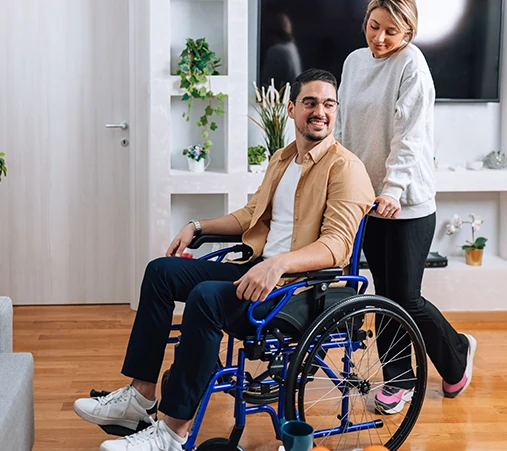
Families and carers: MND at home
MND Australia’s 2025 report put a number on something families already knew. Unpaid carers of Australians with motor neurone disease provided 5.37 million hours of care in 2025, valued at $212.02 million. Informal carers average about 37.5 hours a week — a full-time job, unpaid, on top of whatever else they are doing.
The report also costed the lost income. Productivity losses for people with MND and their carers together came to $367.74 million, or around $133,626 per household. That figure includes the person’s own lost earnings and the carer’s, and it sits alongside a disease that costs the country $5.02 billion a year all up.
So the economic picture is a household absorbing a full-time unpaid job and losing roughly $134,000, over an average of two to three years, usually with no warning and often in late middle age when a mortgage is still running.
This guide is about that. What the load actually consists of, what the particular griefs of MND are, what practically reduces the burden, what support exists that families do not know about, and the things worth saying out loud.
It is written primarily for partners, adult children and parents providing the care. Support workers have their own guide.
What the load actually consists of
The physical care is the part everybody anticipates. It is rarely the heaviest part.
The physical care. Showering, dressing, toileting, transfers, repositioning, feeding or managing PEG feeds, suction, mask fitting, medications, pressure care. Increasingly, several times a night. The transfers are where carers get hurt — back injuries among MND carers are common and underreported, and they frequently end the home arrangement, which means a hoist is a protection for two people rather than one.
The interpreting. As speech deteriorates, the person nearest them becomes the translator. Nobody else understands, so every conversation with every professional routes through one person, who is also the person most tired. This is exhausting in a way that is hard to convey and it rarely appears on any assessment.
The administration. The NDIS or My Aged Care application, then the reassessments. Equipment quotes and funding requests. Appointments with the neurologist, respiratory physician, speech pathologist, dietitian, OT, physiotherapist, palliative care team, GP. Insurance claims and superannuation. Centrelink. The solicitor. The licensing authority. The employer. The bank. And the re-explaining of the whole situation to every new person.
The vigilance. Listening at night. Checking the machine. Noticing the chest sounds different. This is the thing that stops carers sleeping even when they are not actively doing anything, and it is why respite that lets somebody sleep is worth more than respite that lets them go out.
The anticipating. Knowing that the next thing is coming and trying to be ready for it. Families in MND live about four months ahead of the present, permanently.
And the ordinary life that continues. Work, other children, elderly parents, the house, the bills.
The griefs that are specific to MND
Worth naming, because they are not the same as other conditions and families frequently feel their reactions are disproportionate when in fact they are precisely proportionate.
It is fast. MND does not give families the years that most progressive conditions give them to adjust. Diagnosis to death averages two to three years, and the first year is substantially consumed by diagnosis, funding applications and equipment. The adjustment time is roughly none.
The mind is usually present. Unlike dementia, the person is typically fully there — following everything, aware of everything, grieving alongside you. That is a mercy and it is also brutal, because you are both watching the same thing happen with the same clarity. Couples describe the particular pain of grieving together for one of them.
The voice goes. This is the loss families rank highest, above mobility. You lose conversation. You lose being argued with. You lose the specific sound of somebody’s laugh. A communication device returns the content and cannot return the person’s voice — which is exactly why voice banking and message banking matter so much, and why they have to be done early. See communication and voice banking with MND.
The role change is total and compressed. Partner to carer in eighteen months. The person who managed the money, drove, cooked, made the decisions, now needs help to the toilet. People talk about losing the marriage while the person is still in the house.
Nobody knows what it is. MND is uncommon enough that most people have not heard of it, which means every conversation starts with an explanation. There is no equivalent of the public understanding that cancer has. Support groups frequently become the only place where explanation is unnecessary.
Where there is cognitive change, the grief is different again. Up to 15 per cent of people with MND develop frontotemporal dementia and over half have some change in thinking or behaviour. Apathy, irritability, loss of filter and rigidity are read as character rather than disease, and families end up resentful and then guilty about being resentful. See cognitive and behaviour change in MND.
And anticipatory grief, which has no social licence. Grieving somebody who is still alive attracts no sympathy and no ritual. People feel they have no right to it. They do.
Children and young people
Where there are children at home, a few things are consistently true.
They know something is wrong. Long before anybody tells them. Children read atmosphere with great accuracy and fill gaps with worse explanations than the truth — commonly that it is their fault, or that the other parent is also about to die.
Tell them, at their level, and keep telling them. One conversation is not enough; understanding gets rebuilt at each developmental stage. Use the word, say it is an illness of the nerves and muscles, say that nobody caused it and it is not catching, and answer what they ask rather than what you fear they are asking.
Honesty about prognosis, pitched carefully. Lying is worse, because when the truth arrives the child learns both that their parent is dying and that they cannot trust what they are told. “The doctors can’t make it better, and he will get weaker” is more useful than a false promise.
Tell the school. Teachers notice changes and can be enormously supportive, and a child’s drop in schoolwork should be understood rather than disciplined.
Let them help, in small defined ways that fit their age, and do not let the burden become structural. Young carers exist in MND households and they need their own support rather than praise for coping.
Protect something ordinary. Sport, friends, a club, a routine that has nothing to do with illness. This matters more than almost anything else.
And help the person with MND leave something. Letters, recordings, a video, a message for each birthday, something written for a future wedding. People with MND frequently want to do this and do not know how to raise it. The banked voice recordings serve this purpose too. This is among the most valuable things a family can do and it has to be done while there is capacity and voice.
Dementia Australia’s National Dementia Helpline on 1800 100 500 supports MND/FTD families. For children specifically, the state MND association on 1800 777 175 can usually point to local counselling, and Carer Gateway offers counselling for carers of any age.
What actually reduces the load
Specific, in rough order of impact.
Get the hoist early. The single most useful piece of equipment for the carer, and the one most often delayed. It prevents the back injury that ends the home arrangement. Borrow one from the state MND association equipment loan library — free, no funding approval needed, delivered and set up — rather than waiting months for a funded one. 1800 777 175. See equipment and home modifications.
Get overnight support before you are desperate. Sleep deprivation is what breaks carers, not the care. Under an NDIS plan this is fundable; a sleepover is a flat nightly rate and active overnight support is charged hourly. See supported independent living with MND.
Register with Carer Gateway on 1800 422 737. Free, national, and most carers have never heard of it. It provides counselling, coaching, peer support, respite, emergency respite, and in some cases financial assistance for practical help. It is independent of the person’s own funding and does not depend on whether they are in the NDIS or aged care. This is the first call a carer should make for themselves.
Claim what you are entitled to. Carer Payment and Carer Allowance through Services Australia for the carer; Disability Support Pension for the person. Separate from the NDIS, which is not income — it funds supports and pays nothing to live on. Ask about expedited assessment on terminal illness grounds.
Find the insurance and superannuation. This is frequently the largest single financial intervention available and most households do not know it exists. MND Australia’s report notes that many people with a terminal diagnosis are unaware they can access superannuation and insurance benefits early. See planning ahead with MND.
Get an MND advisor. Free, through the state association, and they know the local routes through everything. For a household outside the NDIS this is the closest thing to support coordination available.
Get support coordination funded if the person is an NDIS participant, and treat it as the point of the plan rather than an extra. The coordination load in MND rises while the household’s capacity to manage it falls.
Make one document and reuse it. A two-page summary — diagnosis, dates, current function, medications, equipment, who is involved, what support is in place — sent ahead of every appointment. It stops the same history being reconstructed verbally fifteen times.
Keep one folder with every report and letter. You will need them repeatedly for funding and claims, and getting copies later is harder than keeping them now.
Delegate specific jobs to specific people. Relatives are useless at “let me know if you need anything” and good at “can you take over the Centrelink claim” or “can you do Tuesday nights.”
Ask for early palliative care for symptom management. Breathlessness, secretions, pain and anxiety managed properly reduce the carer’s night-time load directly.
And accept that some things will be done late or badly. The administration is not the care. A family that exhausts itself getting the paperwork perfect has made a bad trade.
For the carer, specifically
Your health is part of the care plan. A carer who injures their back or collapses ends the arrangement. Keep your own GP appointments. Get the physiotherapy referral for your back before you need it. Eat and sleep as though it matters, because it does.
Learn the transfers properly. Ask the physiotherapist or OT to teach you, and ask again when equipment changes. Most carer injuries come from improvised techniques.
Say the resentment out loud somewhere. To a counsellor, to a peer support group, to a friend. Resentment in this situation is universal and it does damage only when it has nowhere to go. It is not a failure of love.
Protect one thing that is yours. An hour, a walk, a friend, a class. Not as self-indulgence — as maintenance.
Accept help in concrete form. People want to help and are bad at offering usefully. Give them a job: a meal on Thursdays, the lawn, a lift to an appointment, an hour sitting with him while you sleep.
Find other MND families. State associations run groups and online communities. The value is not information; it is not having to explain.
Plan for after. Carers of people with MND frequently describe a collapse in the months following the death — the structure, the purpose and the routine all disappear at once, along with the person. Bereavement support exists through palliative care services, Carer Gateway and the state MND associations, and research into families bereaved by MND has described carers as the hidden patients for exactly this reason. Knowing in advance that it is coming helps.
And let yourself be told you did enough. Nobody does this well. Everybody loses their temper, resents it, gets things wrong, and wishes they had been more patient. The bar is not perfection; the bar is that you stayed.
The conversations worth having while you can
Families consistently report that the things they most regret are conversations they did not have, and the window for them is narrower in MND than in almost any other condition — speech goes, and in a substantial minority cognition changes too.
The practical ones, which are also the easiest. Where things are. Passwords. The accounts, the insurance, the mortgage, the will, who the accountant is, what the plan was for the shed. Write it down together, as a list, because this is the material a grieving family hunts for in a filing cabinet six months later. Doing it as an administrative exercise rather than a deathbed scene makes it much easier to start.
What they want, specifically. Not “he wouldn’t have wanted a fuss” — actual answers. Which house, which bed, which room, at the end. Whether they want hospital admission. What they want done about ventilation if it comes to that. Who they want in the room and who they do not. Music. The funeral, if they want to say. These belong in an advance care directive and in the family’s shared understanding. See planning ahead with MND.
The things nobody says because there is time. There is not as much as it feels like. The regret families report most is not having said something obvious — thank you, I’m sorry about that year, I never told you what that meant to me, I forgive you. People assume there will be a right moment and the right moment turns out to have been a Tuesday eighteen months ago when speech was still easy.
The recordings. While there is a voice. Not only banked words for a device, but recordings made for people: a message for each grandchild, something for a wedding, a letter read aloud, the story of how they met. Families describe these as the single most valuable thing they have afterwards, and almost nobody does it early enough. See communication and voice banking.
And the permission. Many people with MND worry intensely about what they are costing the people around them and want to be told it is alright. Many carers need to hear that they are allowed to be tired, allowed to want it over, and allowed to have a life afterwards. Both of those are conversations that are easier to have in month three than in month twenty-two.
Families and Carers: Living With MND at Home: common questions
MND Australia’s 2025 report found unpaid carers provided 5.37 million hours in Australia that year, valued at $212.02 million, with informal carers averaging around 37.5 hours a week. Lost productivity for people with MND and their carers together came to around $133,626 per household. It is a full-time unpaid job, usually arriving without warning.
Two things, both free. Ring Carer Gateway on 1800 422 737 and register — counselling, coaching, peer support, respite and emergency respite, independent of the person’s own funding, and most carers have never heard of it. And ring the state MND association on 1800 777 175 to borrow a hoist from the equipment loan library at no cost, without waiting for funding approval. The hoist prevents the back injury that most often ends a home arrangement.
Yes, universally, and it is not a failure of love. The combination of a full-time unpaid job, broken sleep, lost income, a changed relationship and anticipatory grief produces resentment in essentially everybody who goes through it. It does harm only when it has nowhere to go, which is an argument for counselling or a peer group rather than for feeling guilty about it.
The truth, pitched to their age, repeated as they grow. They already know something is wrong and will invent worse explanations — commonly that it is their fault. Name the illness, say nobody caused it and it is not catching, answer what they actually ask, tell the school, let them help in small defined ways, and protect something ordinary in their life that has nothing to do with illness.
Several things. Carer Gateway on 1800 422 737. The state MND association’s free equipment loan library, which supplies hoists, beds, wheelchairs and communication aids without requiring funding approval. MND advisors, free and knowledgeable about local routes. Early referral to palliative care for symptom management. And the superannuation and insurance terminal illness provisions, which MND Australia has specifically noted most people with a terminal diagnosis do not know exist.
Because it takes the relationship rather than the function. Mobility loss is managed with equipment; the loss of conversation, of being argued with, of the specific sound of somebody’s laugh, is not replaceable. A communication device restores the content and not the person. This is the strongest argument for doing voice banking and message banking in the first weeks after diagnosis, while there is still a voice to record.
Many describe a collapse in the months following the death, because the structure, routine and purpose disappear at the same moment as the person. Research into families bereaved after MND has described carers as the hidden patients. Bereavement support is available through palliative care services, Carer Gateway and the state MND associations, and knowing in advance that the collapse is likely makes it easier to plan for and ask for help.




